
How Many Solar Panels Do I Need for My Home?
Most homes need between 15 and 25 panels, but your number depends on usage, roof, and sun exposure. Here is how installers actually calculate it.
In this article
The Direct Answer
Most homes in Pennsylvania, New Jersey, and Delaware typically require between 15 and 25 solar panels to meet their energy needs. The exact number varies based on several key factors:
- Annual electricity consumption: The total amount of electricity your household uses in a year, measured in kilowatt-hours (kWh).
- Panel wattage: The power rating of each solar panel, usually ranging from 350W to 470W.
- Sun exposure: How much sunlight your roof receives, influenced by orientation, tilt, and shading.
- Offset target: The percentage of your electricity usage you want your solar energy system to cover, whether partial or full.
Understanding these key factors helps you make a cost effective investment and ensures your solar installation aligns with your electricity needs and goals. Each home is unique, so a professional solar design tailored to your specific situation will provide the most accurate system size and maximize your energy independence.
The Formula Installers Actually Use
Strip away the software and the satellite imagery, and system sizing comes down to one division problem: your annual electricity usage divided by the annual production of one panel at your location equals the number of panels you need. Both parts of this equation deserve closer examination because each hides variables that can significantly affect the answer.
Step 1: Find your annual usage
Pull your last 12 months of electric bills and add up the kilowatt-hours. Annual energy use is measured in kilowatt-hours (kWh), which is the total amount of energy you use over time. Not the dollar amounts, the kWh. Every utility in our region (PECO, PSE&G, PPL, JCP&L, ACE, Delmarva, and the rest) prints monthly electricity usage on the bill, and most show a 12 month usage history chart in their online portals, so your utility bill is the best place to verify actual electricity consumption.
Twelve months matters. A July electricity bill alone overstates your needs because of air conditioning. A March bill understates them. The annual total is the only honest baseline for annual consumption.
For reference, a typical household in our region uses somewhere between 9,000 and 13,000 kWh per year, though homes with electric heat or an EV can run well above that, and efficient smaller homes run below it. By comparison, the average American household used 863 kWh per month in 2024, which is useful context but less important than your home’s actual bill history.
Need help finding your annual kWh usage?See how to read your electric bill with solar.
Step 2: Understand what one panel produces
Modern residential panels typically fall in a 350W to 470W range, so solar panel wattage varies by model. But the rating is a laboratory number. What matters is annual energy output at your address, which depends on direct sunlight, how much sunlight your region receives, your roof’s orientation and tilt, and shading.
In the Mid Atlantic, a well placed panel typically produces in the neighborhood of 1.1 to 1.3 kWh per year for every watt of rated capacity. The production ratio, which typically ranges from 1.0 to 1.6, reflects local weather patterns, peak sun hours, and system losses that are often around 14% to 20%, which is one reason real world energy production falls below nameplate expectations. At that ratio a 400 watt panel produces roughly 440 to 520 kWh a year. South facing roofs sit at the top of that range. East and west facing roofs produce roughly 80 to 90 percent as much. Shading pulls the number down further, sometimes dramatically.
Step 3: Decide your offset target
Most homeowners aim to offset as close to 100 percent of their annual usage as the roof allows. Net metering in all three of our states makes that goal worthwhile: summer overproduction earns credits that cover winter consumption, so a system sized to your annual total balances out across the year.
But 100 percent is not mandatory. If your roof can only support enough panels for 70 percent offset, that system still cuts most of your supply charges, and at current rates in this region, that is meaningful money. Partial offset is not failure. It is the right answer for some roofs.
Not familiar with the credit system that makes annual offset possible? Learn what net metering is and how it works.
The Variables That Change Your Number
The number of solar panels you need can be affected by several variables:
How you heat your home
- Gas heat keeps your electric usage moderate.
- Electric resistance heat or a heat pump shifts your heating load onto the electric bill and can substantially increase your annual kWh, which means more panels.
- If you are planning to convert from oil or gas to a heat pump in the next few years, your installer needs to know now, not after the system is on the roof.
Electric vehicles, current and planned:
- An EV charged at home adds real load: typically 2,000 to 4,000 kWh per year depending on mileage.
- If you already drive one, the load is in your bills.
- If one is coming, sizing for it upfront avoids an expansion project later.
Roof geometry:
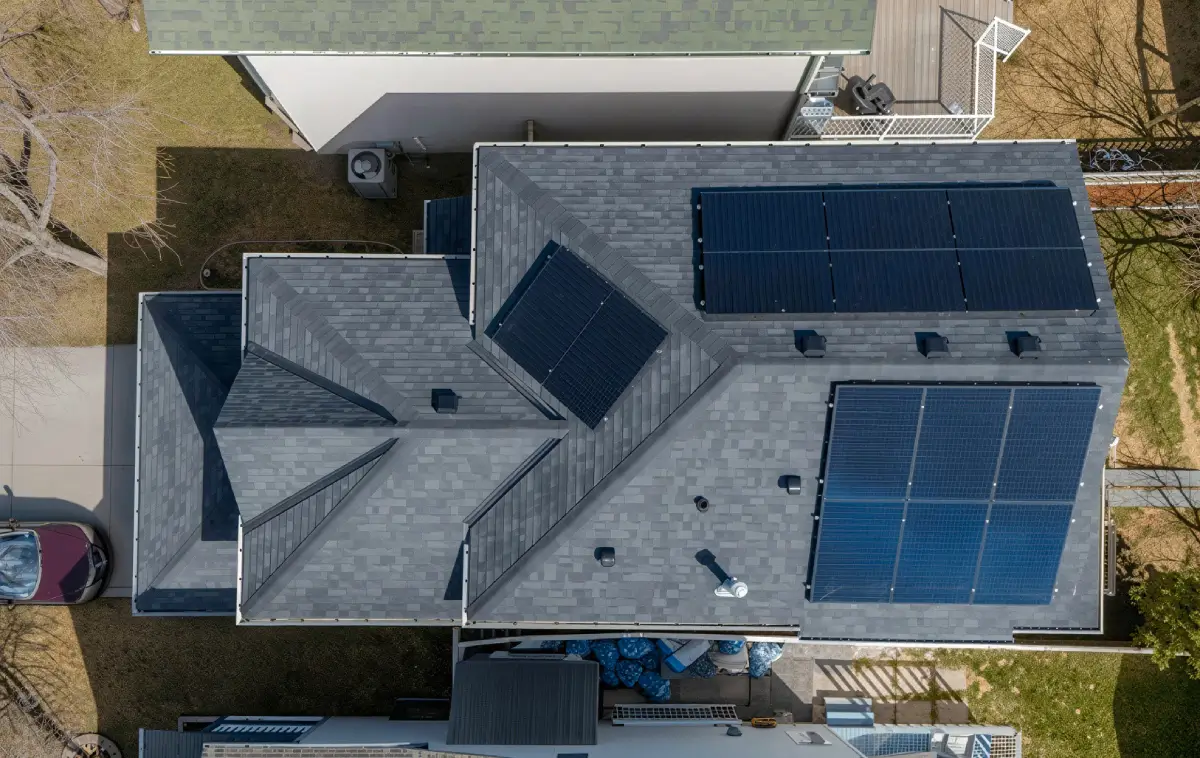
- Panel count is constrained by available space, and the usable roof area has to fit the recommended system size.
- Chimneys, vents, skylights, dormers, and required setbacks from roof edges all subtract roof space.
- A large, simple roof plane can hold more panels than a cut up roof of the same total square footage, because complex roof designs may limit placement options even when it looks like there is enough room.
- Higher wattage panels partially compensate for limited area by producing more per panel, so higher efficiency options can hit the same target with fewer panels when how much roof space is tight.
Shading
- A mature oak on the south side of your house can do more to your panel count than every other variable combined.
- Sometimes the answer is panel level electronics that minimize shade losses.
- Sometimes it is putting panels on a different roof plane.
- Where a site has heavy shading or limited usable roof area, the assessment shows what production is achievable and which layout options apply.
Pool pumps, hot tubs, additions:
- Anything that adds sustained electric load belongs in the sizing conversation.
- The goal is a system designed for how you will live in the house, not a snapshot of last year, so your installer can account for solar panel requirements as well as future changes in system size.
Why Online Calculators Get You Close but Not There
A good online estimator can take your monthly bill or usage and produce a panel range. That is a useful starting point, and our own savings calculator will do exactly that with your utility’s actual rates.
What no calculator can see: the shade pattern from your neighbor’s trees at 3 p.m. in October, the structural condition of your roof deck, the orientation split between your roof planes, or the local utility’s interconnection limits. Those come from a site assessment, and they are the difference between an estimate and a design.
The practical workflow looks like this. Use the calculator to get oriented. Pull your 12 month usage so you know your real number. Then let a designer turn those inputs into an actual layout with a production model for your specific roof.
What a Real System Design Includes
When Sunwise designs a system, the panel count is the output of a defined process. We start with your 12 months of utility usage data. We model your roof from satellite imagery and confirm with an on site assessment. We run shade analysis across the full year, not just summer. We map panel placement around vents, setbacks, and structural features. And we model expected production month by month so you can see how the system performs in January, not just July.
The result is a number with reasoning behind it. Your proposal should connect the panel count to your annual usage, your roof layout and the modeled production for your address.
Get Your Panel Count
The panel count for your home is a question with a real answer, and it costs nothing to get it. A Sunwise consultation includes a full usage review, roof assessment, and a system design modeled on your property to estimate the right solar power before pricing, since installed panels often run about $2.50 to $3.50 per watt, with roughly $2.60 per watt as a common average. No rules of thumb. No pressure.
A typical home solar system often costs about $15,000 to $25,000, while a 12 kW solar system can cost about $31,135 before incentives. Accurate sizing also protects long-term value, since home solar can save roughly $27,000 to $110,000 over 25 years depending on usage and utility rates.
Panel Count FAQs
How many solar panels does the average house need?
Most homes in the Mid-Atlantic region land between 15 and 25 panels, depending on annual electricity usage, panel wattage, roof orientation, and shading. Homes with high consumption, electric heat, or an EV may need more. Homes with modest usage and a well-oriented roof may need fewer. The only accurate number comes from a design built on your actual usage history.
How do installers calculate the number of panels needed
Installers start with your annual electricity usage in kilowatt-hours, pulled from 12 months of utility bills. They divide that by the expected annual production of a single panel at your location, which accounts for panel wattage, roof orientation, tilt, and shading. The result is the panel count needed to offset your target percentage of usage.
Do I need more solar panels if I have an electric vehicle?
Usually, yes. An EV charged primarily at home can add 2,000 to 4,000 kWh to your annual electricity usage depending on how much you drive. If you already own an EV, that usage shows up in your bills. If you plan to buy one, tell your installer so the system can be sized for the future load rather than just your current usage.
Can I add more panels later if I need them?
Often yes, but it is more efficient to size correctly the first time. Adding panels later may require inverter changes, a new interconnection application with your utility, and additional permitting. If you anticipate higher future usage from an EV, heat pump, pool, or addition, building that into the original design is almost always the better path.
What if my roof cannot fit enough panels to cover my usage?
Partial offset is still valuable. A system that covers 60 or 70 percent of your usage still cuts the majority of your supply charges at current rates. Higher-wattage panels can also increase production from limited roof area. Your installer should show you the maximum realistic offset for your roof and what that does to your bill.