
How to Read Your Electric Bill With Solar Panels
How to read your electric bill after solar: what each charge covers, where your net metering credits appear, and how the annual true-up works.
In this article
What Changes on Your Bill After Solar
After solar, your utility bill shows the electricity you drew from the grid, the excess power you exported, and the credits applied to your account. The fixed grid connection charge stays.
What changes is the shape of it. A solar bill has new line items, much smaller usage charges, and a credit balance running in the background. This guide walks through each section, shows where your production appears, and explains the seasonal patterns that make the first year look different from the years after it.
If you have not gone solar yet, this is a preview of what your bills will look like. If your system just got turned on and your first bill confused you, start at the section on your first bill below.
The Anatomy of an Electric Bill (With or Without Solar)
Every residential bill in our region, whether from PECO, PSE&G, PPL, JCP&L, Atlantic City Electric, or Delmarva Power, breaks into the same basic pieces, even though each utility formats them differently.
The Fixed Charges
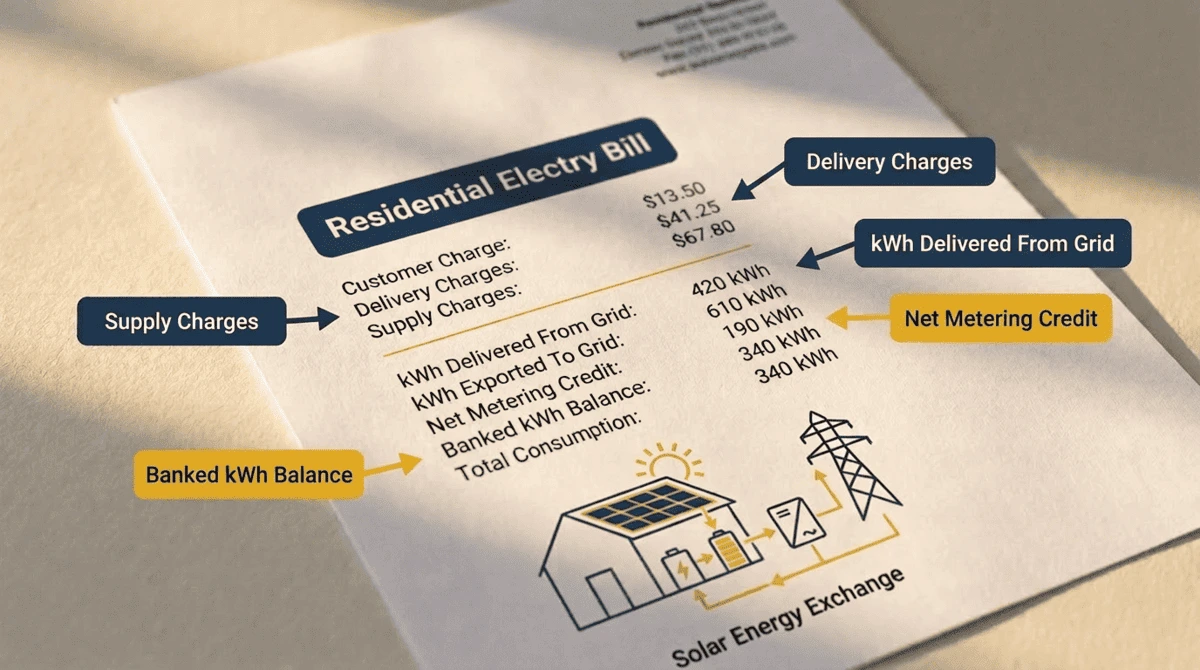
A customer charge or service charge appears on every bill regardless of how much electricity you use. This is the cost of being connected to the grid: the meter, the wires to your house, the account itself.
This charge stays with solar, and your proposal should account for it. It is typically a modest flat amount each month.
The Delivery (Distribution) Charges
These pay for the poles, wires, transformers, and crews that move electricity to your home.
They are billed per kWh you draw from the grid. When your panels supply your home directly, you draw fewer kWh, and this portion of the bill shrinks accordingly.
The Supply (Generation) Charges
This is the cost of the electricity itself, and it is the part of the bill that has been climbing hardest across Pennsylvania, New Jersey, and Delaware.
It is billed per kWh. Every kilowatt-hour your solar system produces is a kilowatt-hour you do not buy at the supply rate, which is exactly why solar economics have strengthened as rates have risen.
Riders, Surcharges, and Taxes
Smaller line items fund things like energy efficiency programs and infrastructure costs. Some are billed per kWh (solar reduces them), some per account (it does not).
What Changes on the Bill After Solar
Once your system receives Permission to Operate (PTO) and your utility swaps in a bidirectional meter, two new numbers start appearing on your bill, and they are the whole story.
kWh delivered vs. kWh received
Your meter now tracks electricity in both directions. “Delivered” (sometimes “consumption” or “from grid”) is what the grid sent you when your panels were not covering your usage: nighttime, cloudy stretches, heavy-load moments. “Received” (sometimes “generation” or “to grid”) is the excess your panels exported when they produced more than your home was using.
The relationship between those two numbers determines your bill. If you drew more than you exported, you pay for the net difference. If you exported more than you drew, the surplus becomes a credit.
The credit bank
Excess production does not vanish. It accumulates as banked credits, tracked either in kWh or in dollars depending on the utility. Those credits automatically offset future bills. A sunny June might bank enough credit to cover most of a gray January, which is the entire design logic of net metering: the grid functions as your seasonal battery.
Where you find the bank varies. Some utilities print a running banked-kWh balance on the bill. Others show a dollar credit carried forward. Your online account portal usually has the clearest view.
The annual true-up
Net metering accounts reconcile on a 12-month cycle. At the end of the cycle, the utility settles whatever credit balance remains. The mechanics differ by state. New Jersey utilities reconcile annually, with leftover credits paid out at an avoided-cost rate. Delaware tracks credits in kilowatt-hours and lets you pick your annual true-up month, zeroing any balance still banked at that point under a 2022 state law, so the choice of month matters. Pennsylvania utilities handle reconciliation per their tariffs, generally compensating annual surplus at a default-service-based rate.
The practical takeaway: sizing a system close to your annual usage is what keeps the true-up simple. Annual surplus beyond that is compensated below retail value, so there is limited benefit in sizing well past your own consumption.
Reading Your First Bill After Solar
The first post-solar bill is where expectations meet reality, and a few timing quirks routinely cause false alarms.
Check the billing period against your PTO date
If your system was activated mid-cycle, your first bill covers days before and after activation. A bill covering three solar weeks and one pre-solar week will not look like the projections. The second full-cycle bill is the first honest one.
Match the bill against your monitoring app
Your production monitoring shows what the system generated. The bill shows what you imported and exported. The gap between production and export is what your home consumed directly from the panels in real time, which never appears on the utility bill at all. That is why production and billed export rarely match. The self-consumed portion never passes through the meter.
Know what season you started in
A system activated in October will run several low-production months before it ever gets to bank summer credits. The first winter looks underwhelming on paper. By the following autumn, with a full summer of banked credits in the account, the 12-month picture looks the way the design projected. Judge the system on a year, not a month.
Why Is My Bill Still High With Solar?
Several things can explain it, and they are worth checking in this order.
The system has not received PTO yet. Installation and activation are separate events. Until the utility grants Permission to Operate, the panels sit idle and the bill is a normal bill.
It is winter. Production is seasonally low and the credit bank may be thin, especially in year one. See above.
Usage went up. New EV, new hot tub, a heat pump, more people in the house, a brutal heat wave. The bill reflects net usage, so consumption growth shows up even when the system performs perfectly. Compare this year’s kWh usage to last year’s, not just the dollar amounts.
The system was sized for partial offset. If the roof supported 70 percent offset, 30 percent of usage still comes from the grid by design. That bill is smaller, not zero.
Rates went up. Supply rates across the region keep climbing. The grid power you do still buy costs more than it used to, which paradoxically makes the solar portion more valuable while keeping the residual bill visible.
Something needs service. A tripped breaker, an inverter fault or a monitoring alert that went unnoticed will all show up as production below the design estimate. If any of the numbers on your bill or in your monitoring app do not match what you expected, call your installer and ask for a review. Meter configuration and credit posting are worth checking too, since those are billing questions rather than equipment ones.
What a Healthy Solar Bill Looks Like
Across a full year, a well-designed system in our region produces a recognizable pattern. Spring and summer bills shrink to near the fixed charges, with surplus kWh flowing into the bank. Fall bills draw the bank down. Winter bills are the largest of the year but still sit well below pre-solar levels, supported by leftover credits. The annual total is where the design promise lives, and it is the number worth tracking.
If you want a benchmark: pull your last pre-solar year of bills and your first full post-solar year, and compare annual kWh purchased and annual dollars paid. That comparison, not any single month, tells you what the system is actually doing.
See What Your Bill Would Look Like
A Sunwise consultation starts with your actual bills. We model your usage against a system designed for your roof and show you, month by month, what the new bill structure looks like, including the credit bank, the seasonal swing and the annual total.
Solar Bill FAQs
Do you still get an electric bill with solar panels?
Every grid-connected solar home still receives a monthly bill. It includes a fixed customer or service charge for the grid connection, charges for any electricity drawn from the grid beyond what your panels produced, and a record of net metering credits earned from excess production. For a well-sized system, the usage charges shrink dramatically, but the bill itself never disappears.
Why is my electric bill still high with solar?
The most common reasons are seasonal timing (winter bills reflect lower production before summer credits accumulate), increased household usage after installation, a system sized to partial offset, or the bill arriving before the system received Permission to Operate. Checking your production monitoring against the kWh on the bill identifies the cause. If production matches the design estimate and usage has not changed, the pattern typically corrects across the full year.
Where do net metering credits show up on my bill?
Each utility presents credits differently, but you are looking for two numbers: kWh delivered to you by the grid, and kWh received by the grid from your system. The difference determines whether you owe for net usage or banked a credit. Credits typically appear as a banked kWh balance or a dollar credit line that rolls forward to future bills.
What is a solar true-up?
A true-up is the annual reconciliation of your net metering account. At the end of a 12-month cycle, the utility settles any remaining credit balance. Depending on your state and utility, excess credits may be paid out, carried forward, or reset. New Jersey utilities reconcile annually with payout at an avoided-cost rate, while Delaware tracks credits in kilowatt-hours and zeroes any balance still banked at a customer-selected annual true-up.
Which charges stay on my bill with solar?
Fixed monthly charges remain regardless of production. These include the customer or service charge for your grid connection and, depending on the utility, certain riders and fees that are billed per account rather than per kWh. Solar offsets the usage-based portions of the bill, which are the parts that have been rising fastest.