The Short Answer
Yes, New Jersey has net metering, and it is the strongest version of the policy operating at the highest rates in the region. PSE&G, JCP&L, Atlantic City Electric, and Rockland Electric are all required to credit residential solar customers at the full retail rate for excess electricity sent to the grid, one kilowatt-hour exported for one kilowatt-hour of credit.
What makes the NJ version notable is not the structure, which several states share. It is the arithmetic. When the retail rate is roughly 26 cents per kWh in PSE&G territory and pushing 30 cents in parts of ACE territory, a one-to-one credit is worth nearly double what the same policy delivers in lower-rate states. New Jersey homeowners get the good policy at the expensive rates, which is exactly the combination you want.
The Legal Foundation
New Jersey’s net metering framework dates to the Electric Discount and Energy Competition Act era and is administered by the NJ Board of Public Utilities. The BPU requires the state’s four investor-owned electric utilities to offer net metering to customer-generators, with crediting at the full retail rate and an annualized reconciliation cycle.
As with Pennsylvania, the requirement lives in regulation, not utility policy. Changing it would require formal BPU action. No such proceeding to weaken residential net metering is active as of 2026, and New Jersey’s broader energy policy continues to lean toward expanding distributed solar, not constraining it.
How NJ Net Metering Works
One-to-one monthly crediting
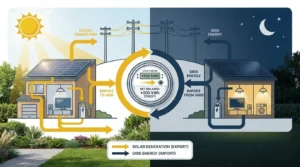
Your bidirectional meter logs imports and exports. Each billing period nets the two. Surplus becomes a credit at full retail value and rolls into the next period. The summer bank carries the winter draw, and the system balances across the year.
Sizing tied to your usage
New Jersey’s program ties eligibility to consumption: the system should be designed so its annual production does not exceed the home’s annual usage. Installers treat 100 percent offset as the design ceiling. This is not a real constraint for homeowners, since producing beyond your usage gets compensated poorly anyway (see the true-up below). It simply codifies what good design does regardless.
The annual reconciliation
At the end of your 12-month annualized period, the utility settles the account. Surplus credits remaining at reconciliation are compensated at an avoided-cost rate, essentially the wholesale value of the energy, which sits far below the 26-cent retail rate your in-year credits earned.
The implication is the same one we make in every sizing conversation: the money is in offsetting your own consumption at retail value, not in overproducing for a wholesale payout. Size to your annual usage. Land near zero at reconciliation. That is the optimized outcome.
Estimate the right system size for your home
Net Metering by NJ Utility
PSE&G
The state’s largest utility, covering the population spine from Bergen County through Newark, the Route 1 corridor, and down into Camden County. Full retail crediting at an all-in rate around 26 cents per kWh makes PSE&G territory one of the most valuable places in America to export a kilowatt-hour.
JCP&L
Central New Jersey: Monmouth, Ocean, Hunterdon, and parts of Morris and Somerset. Same statewide framework. JCP&L customers absorbed the steepest rate increase in the state in 2025, north of 20 percent, which raised the value of every net metering credit correspondingly.
Atlantic City Electric
Southern New Jersey: Atlantic, Cape May, Cumberland, Salem, and parts of Camden, Gloucester, and Burlington counties. ACE rates run 27 to 30 cents all-in, the highest in the region, which makes ACE territory arguably the single strongest net metering math in the Sunwise service area.
Rockland Electric
A small slice of Bergen and Passaic counties in the state’s northern corner. Same framework, smallest footprint.
What Shows Up on Your NJ Bill
Post-PTO, your bill gains the two-direction view: kWh delivered to you and kWh received from you, with the banked balance carried as kWh or dollars depending on the utility’s format. PSE&G’s portal shows the running picture more clearly than the paper bill, and the same is true at JCP&L and ACE.
If the first solar bill raises more questions than it answers, the full line-by-line walkthrough is here:
How to Read Your Electric Bill With Solar
The NJ Stack: Net Metering Plus SREC-II Plus Tax Exemptions
Net metering is one layer of New Jersey’s solar value, and on its own it would already justify most installations at current rates. New Jersey adds three more layers, and they all stack.
The SREC-II program through the ADI pays a fixed rate for every megawatt-hour your system produces, locked for 15 years from registration. As of March 2026 that rate stepped down to $76.50 per MWh for new registrations, from the $85 that held through the prior energy year. Systems registered earlier keep their original rate for the full 15 years, and the BPU adjusts the level periodically, so the rate you lock in depends on when you register. Confirm the current figure at the NJ Clean Energy Program. This payment is production-based, not export-based: energy you consume at home earns it just as energy you export does, and it runs alongside net metering, not instead of it.
The property tax exemption means the home value your solar system adds is not assessed. In a state with the highest property taxes in the nation, that exemption has real teeth.
The sales tax exemption removes New Jersey’s 6.625 percent sales tax from solar equipment purchases.
No neighboring state matches this combination. Pennsylvania has net metering and a weaker, variable SREC market with no tax exemptions. Delaware has net metering and rebates but a competitive SREC lottery. New Jersey homeowners hold the strongest hand in the region, and the rate increases of the past two years only strengthened it.
Current PSE&G electricity rates
Is NJ Net Metering at Risk?
New Jersey’s 1:1 retail net metering remains fully in place in 2026. The BPU has been studying a successor net-metering structure as part of longer-term transition planning, with discussion of value-of-solar export rates, possible grid-access charges, and storage considerations, but nothing has been enacted and current crediting is unchanged. The national pattern also applies here: when states restructure net metering, interconnected customers are grandfathered under their original terms. Systems activated under today’s rules keep today’s rules, which is the practical reason not to wait on a structure that is under review.
Run the Numbers at 26 Cents
A Sunwise consultation models a system against your actual PSE&G, JCP&L, or ACE usage history and shows you the monthly flow: production, exports, credits banked and drawn, SREC-II income, and the annual total. The math in New Jersey is strong. See what it looks like on your house.
New Jersey Net Metering FAQs
Is net metering available in New Jersey?
Yes. New Jersey requires its investor-owned utilities, PSE&G, JCP&L, Atlantic City Electric, and Rockland Electric, to offer net metering at the full retail rate. Excess solar production is credited one-to-one against your consumption, and credits roll forward month to month until the annual reconciliation.
How big can my solar system be under NJ net metering?
New Jersey ties eligibility to your consumption rather than a hard kW cap for residential systems: the system should be sized so annual production does not exceed your annual usage. In practice, installers design NJ systems to offset up to 100 percent of the home’s yearly consumption, which keeps the system inside the program rules and maximizes retail-rate value.
What happens to leftover net metering credits in NJ?
Credits roll over month to month through your annualized period. At the end of the 12-month cycle, the utility reconciles the account and compensates any remaining surplus at an avoided-cost rate, which is well below retail. This makes sizing the system close to annual usage the financially optimal approach.
Does PSE&G offer net metering?
Yes. PSE&G provides 1:1 retail rate net metering to residential solar customers. With PSE&G’s all-in rate around 26 cents per kWh, exported kilowatt-hours in PSE&G territory carry some of the highest credit value in the country. JCP&L, Atlantic City Electric, and Rockland Electric operate under the same statewide framework.
Can I get net metering and SREC-II payments at the same time in NJ?
Yes. They are separate programs that stack. Net metering credits your bill for where your electricity goes. The SREC-II program through the ADI pays a fixed rate per megawatt-hour for everything your system produces, guaranteed for 15 years from registration, regardless of whether that energy was used at home or exported. As of March 2026 the rate for new registrations is $76.50 per MWh, down from $85; systems registered earlier keep their original rate. Confirm the current figure at the NJ Clean Energy Program.