What You’ll Learn
- Why flat roofs are well suited for commercial solar installations
- How ballasted and mechanically attached mounting systems work
- What tilt angles are optimal for the mid-Atlantic region
- Structural load requirements and how they are evaluated
- How different membrane types interact with solar racking
- What building owners should plan for before installation
Can You Put Solar Panels on a Flat Roof?
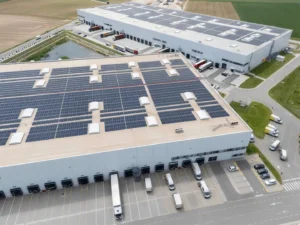
Yes, flat roofs are among the best surfaces for commercial solar installations. Panels are mounted on angled racking systems that tilt them toward the sun for optimal energy production, and the large, unobstructed surface area typical of flat commercial roofs allows for efficient panel layouts that maximize total system capacity. Warehouses, office buildings, retail centers, schools, and industrial facilities across the Northeast regularly install rooftop solar on flat membrane, TPO, EPDM, and modified bitumen roofs.
Flat roof solar is not a compromise. In many cases, it is the preferred configuration for commercial projects because the roof surface is typically free of the dormers, hips, valleys, and chimneys that limit panel placement on pitched residential roofs.
Mounting Systems: Ballasted vs. Mechanically Attached
Solar panels on flat roofs are installed using one of two primary racking systems. The right choice depends on your roof type, structural capacity, local wind load requirements, and building code.
Ballasted Racking
Ballasted systems use weighted trays or frames that sit on the roof membrane and are held in place by concrete blocks or pavers. No fasteners penetrate the roof surface. The weight of the ballast, combined with the weight of the panels themselves and the friction between the racking pads and the membrane, keeps the system in place against wind uplift forces.
Ballasted systems are the preferred option for many flat roof installations because they avoid any penetration of the waterproof membrane. This eliminates the risk of installation-related leaks and makes future roof maintenance or replacement simpler since the solar array can be temporarily relocated without pulling fasteners.
The tradeoff is weight. Ballasted systems add approximately 3 to 6 pounds per square foot of loaded roof area, depending on the ballast plan required for local wind conditions. The structural engineer must confirm that the roof and building structure can support this load in addition to existing dead loads, live loads, and snow loads.
Mechanically Attached Racking
Mechanically attached systems fasten the racking directly through the roof membrane into the structural deck using engineered standoffs with integrated flashing. Each penetration point is sealed with a compatible flashing system that maintains the membrane’s waterproof integrity.
These systems are lighter than ballasted alternatives, typically adding 3 to 4 pounds per square foot, which makes them a better fit for buildings where structural capacity is limited. They also resist wind uplift through fastener strength rather than weight, which can be advantageous in high wind-load zones.
The tradeoff is that each roof penetration must be executed precisely and sealed correctly. Working with an installer experienced in your specific membrane type is essential. Poorly executed penetrations are the most common source of post-installation issues on flat roofs.
Got it. Your details are with Gabrielle.
You’ll hear back within 24 hours at the email you provided.
Tilt Angle and Row Spacing
Because flat roofs provide no natural pitch, the racking system tilts panels at an angle chosen to balance energy production per panel against total system capacity.
In the mid-Atlantic region, including Pennsylvania, New Jersey, and Delaware, solar panels on flat roofs are typically tilted between 10 and 20 degrees south.
Lower tilt angles of 5 to 10 degrees allow tighter spacing between rows because each row casts a shorter shadow on the row behind it. This means more panels can fit in the same roof area, which increases total system capacity and total energy production even though each individual panel produces slightly less than it would at a steeper angle.
Higher tilt angles of 15 to 20 degrees increase each panel’s individual production by capturing more direct sunlight, particularly in winter when the sun is low in the sky. But steeper angles require wider spacing between rows to prevent inter-row shading, which reduces the total number of panels the roof can accommodate.
For most commercial flat roof installations, the optimal tilt falls between 10 and 15 degrees, which maximizes total system production per square foot of available roof area. Your installer models the specific tradeoffs for your building using the actual roof dimensions, setback requirements, and local conditions.
Structural Considerations
Every flat roof solar installation requires a structural evaluation to confirm that the building can support the additional load. This evaluation is typically performed by a licensed structural engineer and considers the weight of the solar array (panels, racking, ballast if applicable), existing roof dead load (membrane, insulation, decking), live load capacity (occupants, maintenance equipment), and local snow load and wind load requirements per building code.
Most commercial buildings constructed to modern codes have adequate structural reserve to support a rooftop solar system without reinforcement. Older buildings, lightweight metal deck structures, or buildings that have been re-roofed multiple times with added layers may need evaluation and in some cases selective reinforcement.
The structural report is completed during the design phase, before installation begins. If it identifies a concern, options include switching from ballasted to mechanically attached racking to reduce weight, reducing system size to stay within load limits, or adding structural reinforcement to specific areas of the roof.
Roof Membrane Compatibility
The type of membrane on your flat roof affects which mounting approach is best suited for the installation.
TPO and PVC Membranes
Thermoplastic membranes are compatible with both ballasted and mechanically attached systems. Ballasted systems use friction pads that sit on the membrane surface. Mechanically attached systems use heat-welded or adhesive-applied flashing boots that bond to the membrane around each penetration point. TPO and PVC are among the easiest membranes to work with for solar installation.
EPDM (Rubber) Membranes
EPDM roofs work well with ballasted racking. Mechanically attached systems require compatible EPDM flashing details that are adhered and sealed rather than heat-welded. Proper material compatibility between the flashing sealant and the EPDM membrane is critical.
Modified Bitumen and Built-Up Roofing (BUR)
Older tar-and-gravel or modified bitumen roofs can support solar, but the installation approach must account for the membrane’s age and condition. Ballasted systems are typically preferred on these surfaces to avoid penetrating aging membrane layers. If the roof is near the end of its service life, re-roofing before solar installation is usually the most cost-effective approach.
Roof Condition and Remaining Life
Just as with residential installations, the age and condition of your flat roof should be evaluated before solar panels go on. Commercial flat roof membranes have typical lifespans of 15 to 25 years for TPO, 20 to 30 years for EPDM, and 15 to 20 years for modified bitumen, depending on maintenance history and environmental exposure.
If the membrane has 10 or more years of remaining life, solar can typically be installed as-is. If the roof is approaching end of life, a re-roofing project should be completed first. Coordinating a membrane replacement with solar installation reduces total project cost and ensures the new roof is designed to accommodate the solar system’s load and attachment requirements.
Solar panels actually extend the life of the membrane beneath them by shielding it from UV radiation, thermal cycling, and direct weather exposure. Areas of the roof covered by panels often last years longer than exposed sections.
What Building Owners Should Plan For
If you own or manage a commercial building with a flat roof and are considering solar, here is a practical checklist to move the project forward:
- Confirm roof age and remaining warranty period. If the roof is within 5 years of needing replacement, plan a combined re-roof and solar project.
- Obtain a structural evaluation. Your solar installer or a structural engineer should confirm the building can support the added load.
- Identify electrical infrastructure. Commercial solar systems tie into the building’s electrical service. Confirm the main service panel, transformer capacity, and available breaker space.
- Review lease terms if applicable. If you lease the building, confirm whether your lease permits rooftop installations and whether landlord approval is required.
- Understand the incentive timeline. Commercial solar projects that begin construction by July 4, 2026 qualify for the 30 percent federal Investment Tax Credit under Section 48E.
👉 Learn about commercial solar tax credits and MACRS depreciation
How Sunwise Can Help
Sunwise Energy designs and installs commercial solar systems on flat roofs across Pennsylvania, New Jersey, and Delaware. We handle structural evaluation, system design, membrane-compatible mounting, permitting, and utility coordination, and we carry Pegasus racking system certification for flat roof installations.
Whether your building is a warehouse, office, school, or retail center, we design around your roof’s specific conditions to maximize production and protect the membrane beneath the array.
Flat Roof Solar FAQs
Can you install solar panels on a flat roof?
Yes. Flat roofs are among the most common and effective surfaces for commercial solar installations. Panels are installed on angled racking systems that tilt them toward the sun, and the large unobstructed surface area on most flat roofs allows for efficient panel layouts.
How are solar panels mounted on a flat roof?
Solar panels on flat roofs are mounted using either ballasted racking, which uses concrete blocks to hold the system in place without penetrating the membrane, or mechanically attached racking, which fastens through the membrane into the structural deck. The choice depends on roof type, wind load requirements, and structural capacity.
What angle should solar panels be tilted on a flat roof?
In the mid-Atlantic region, solar panels on flat roofs are typically tilted between 10 and 20 degrees. Lower tilt angles of 5 to 10 degrees allow tighter row spacing and more total panels, while steeper angles of 15 to 20 degrees increase per-panel production but require more space between rows to prevent shading.
How much weight do solar panels add to a flat roof?
A typical ballasted flat roof solar installation adds 3 to 6 pounds per square foot, including panels, racking, and ballast weight. Mechanically attached systems are lighter at approximately 3 to 4 pounds per square foot. A structural engineer evaluates whether the existing roof structure can support the additional load.
Will solar panels damage my flat roof membrane?
When installed correctly, solar panels should not damage a flat roof membrane. Ballasted systems avoid roof penetrations entirely. Mechanically attached systems use engineered flashing and sealant details designed to maintain the membrane’s waterproof integrity. In many cases, the panels actually protect the membrane from UV degradation and extend its lifespan.
Do flat roof solar panels produce less energy than pitched roof systems?
Not necessarily. While flat panels would produce less energy than optimally angled ones, flat roof solar installations use tilt racking that angles panels toward the sun. The production per panel is comparable to pitched roof systems, and the larger available area on flat roofs often allows for higher total system capacity.
The information in this guide is for informational and educational purposes only and does not constitute legal, financial, or tax advice. We are not licensed tax advisors or financial professionals. The tax laws and regulations discussed are complex and subject to change and interpretation. Consult with a qualified tax professional to understand how these provisions apply to your organization’s specific circumstances.