
What You’ll Learn
- How rising commercial electricity rates in PA, NJ, and DE affect operating costs for different building types
- Why warehouses, manufacturing facilities, and distribution centers are ideal candidates for commercial solar
- How solar changes the operating cost equation for offices and retail properties
- What federal tax incentives (Section 48E, MACRS) are still available for commercial solar in 2026
- How to evaluate whether solar makes sense for your building
Introduction
Electricity is one of the largest controllable operating expenses for commercial buildings. Whether you operate a warehouse, a manufacturing facility, an office building, or a retail location in Pennsylvania, New Jersey, or Delaware, your electricity cost has almost certainly increased over the past two years.
Commercial rates across the region have risen sharply, driven by the same PJM capacity market dynamics pushing residential bills higher. For businesses that consume large volumes of electricity, those rate increases translate directly into higher operating costs, tighter margins, and more volatility in budgeting.
Solar does not eliminate every line item on your electric bill. But it does something that no other operating cost reduction strategy can: it converts a variable, unpredictable expense into a fixed cost that does not change for decades. For commercial buildings with significant roof area and meaningful electricity consumption, that shift in cost structure can materially improve the financial performance of the property.
Why Commercial Electricity Costs Are Rising
The same forces driving residential rate increases are hitting commercial customers. PJM capacity auction prices surged over 800 percent in the most recent cycle. Utilities across PA, NJ, and DE have passed those costs through in the form of higher supply charges. Distribution rate increases have layered on top.
For commercial customers, the impact is amplified by scale. A warehouse consuming 50,000 kWh per month absorbs rate increases across every one of those kilowatt-hours. A 2-cent-per-kWh increase that adds $15 to a residential bill adds $1,000 per month to that warehouse’s operating costs. Over a year, that is $12,000 in additional expense for the same amount of electricity.
Commercial electricity rates across the Sunwise service area now range from approximately 19 to 30 cents per kWh depending on the utility and rate class. These rates are not expected to decrease. The structural supply-demand imbalance in the PJM region, driven by data center growth, power plant retirements, and interconnection delays, is a multi-year condition.
For a closer look at regional pricing, see current PECO electricity rates in 2026 and how electricity rates in New Jersey are evolving with PSE&G.
How Solar Works for Different Building Types
Not every commercial building benefits from solar in the same way. The economics depend on roof characteristics, electricity consumption patterns, and how the building uses energy throughout the day. Here is how solar applies to the most common commercial building types in our service area.
Warehouses and Distribution Centers
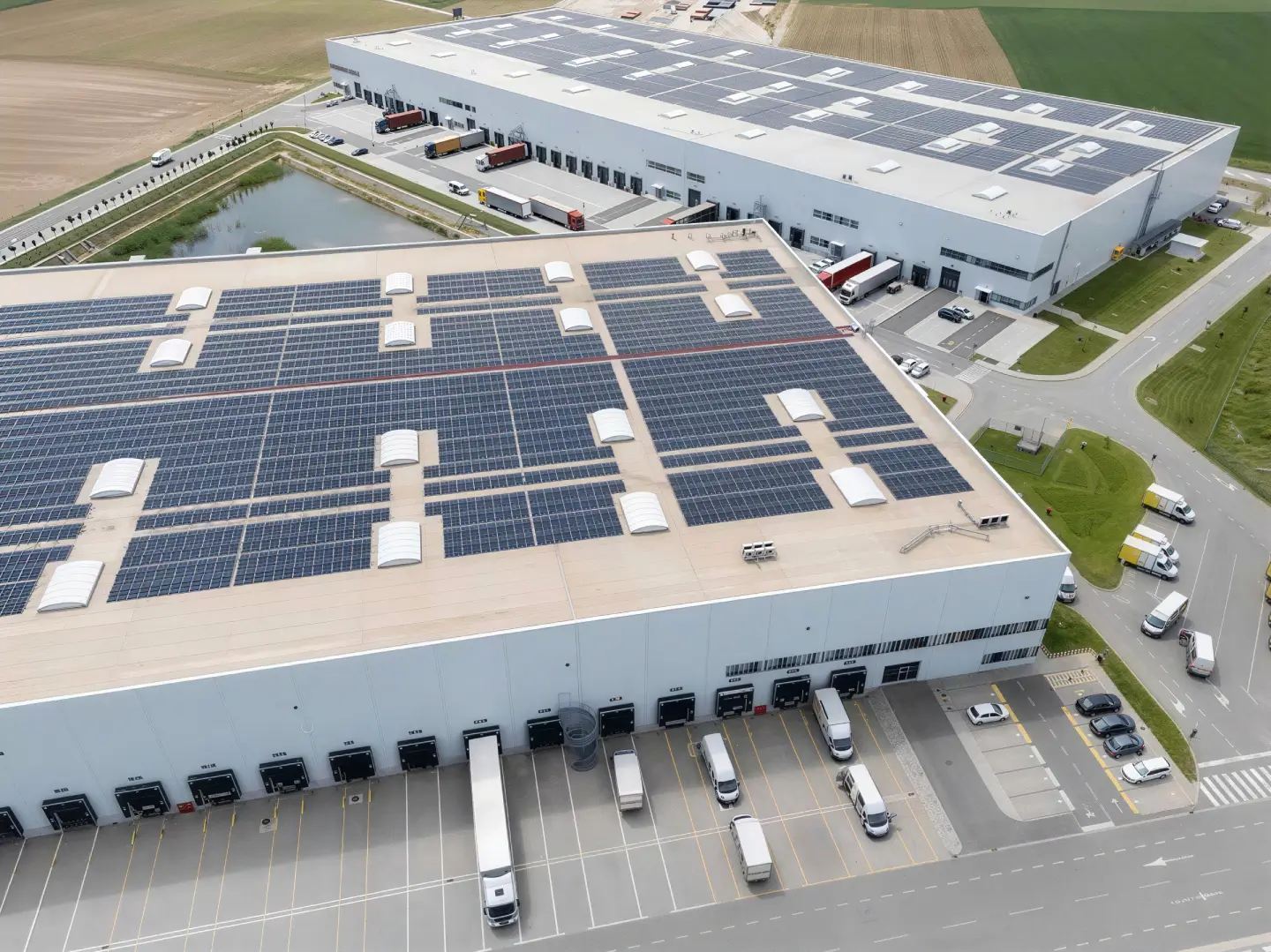
Warehouses are the single best building type for commercial solar. They have large, flat rooftops with few or no obstructions (no HVAC equipment forests, no skylights, minimal penetrations). The available roof area can often accommodate a solar system large enough to offset a significant portion of the building’s electricity consumption.
Warehouse electricity loads are typically driven by lighting, dock doors, climate control for temperature-sensitive inventory, and material handling equipment. Many of these loads operate during daylight hours, which aligns well with solar production peaks. The combination of large roof area, daytime energy consumption, and high per-building electricity volume makes warehouses consistently strong solar candidates.
Manufacturing Facilities
Manufacturing facilities present a compelling but more variable case. Electricity loads can be very high, driven by production equipment, compressed air systems, process cooling, and lighting across large floor areas. If the facility operates primarily during daytime shifts, solar production aligns well with consumption patterns. Facilities running 24/7 operations can still benefit, but a smaller percentage of total consumption is offset during peak solar hours.
Roof conditions matter more for manufacturing buildings because of equipment penetrations, exhaust systems, and structural considerations. A thorough site assessment determines how much usable roof area is available and whether the structure can support the added load.
Office Buildings
Office buildings typically consume less electricity per square foot than industrial facilities, but their consumption pattern is highly favorable for solar. Peak electricity demand in offices occurs during business hours, driven by HVAC, lighting, elevators, and plug loads. Solar production peaks during the same hours, creating a natural match between generation and consumption.
For property owners with multi-tenant office buildings, solar can be positioned as a building amenity and a hedge against rising common-area electricity costs. For owner-occupied offices, solar provides direct operating cost reduction on one of the building’s largest utility line items.
Retail Properties
Retail locations, strip malls, and standalone retail buildings face some of the highest electricity costs per square foot due to lighting, signage, refrigeration (for food retail), and HVAC. Solar can offset a meaningful share of these costs, particularly for buildings with flat roofs or large canopy areas.
For multi-tenant retail properties, the savings structure depends on how electricity is metered and billed. Properties with a master meter offer the most straightforward path to solar savings for the property owner.
The Commercial Solar Financial Advantage in 2026
Commercial solar retains significant federal tax advantages that are no longer available to residential homeowners. This makes 2026 a particularly strong window for commercial installations.
Section 48E Investment Tax Credit
The commercial ITC under Section 48E remains available at 30 percent for solar systems that begin construction by July 4, 2026, and meet prevailing wage and apprenticeship requirements. This credit applies to the full cost of the installed system, including equipment, labor, and soft costs. For businesses with sufficient tax liability, the credit directly reduces the net investment by nearly one-third.
Additional adders are available for systems that meet domestic content requirements (an additional 10 percent credit) or are sited in energy communities (an additional 10 percent credit). These adders can push the effective credit to 40 or even 50 percent for qualifying projects.
MACRS Accelerated Depreciation
Commercial solar systems qualify for Modified Accelerated Cost Recovery System (MACRS) depreciation on a 5-year schedule. Combined with first-year bonus depreciation (if still available at the applicable rate), this allows businesses to recover a significant portion of the system cost through tax deductions in the early years of ownership.
The combination of Section 48E and MACRS makes the after-tax cost of a commercial solar system substantially lower than the gross installed price. For profitable businesses with tax liability, this is the most powerful financial lever in commercial solar.
Learn how these incentives work together in our guide to commercial solar tax credits.
State-Level Incentives
Commercial solar systems in PA, NJ, and DE also benefit from state incentive programs. Pennsylvania’s SREC market, New Jersey’s SREC-II program (through the ADI at $85/MWh for 15 years), and Delaware’s Green Energy Program each provide additional value layers that improve commercial solar ROI. Net metering rules in all three states allow commercial systems to earn credits for excess production, further reducing electricity costs.
What Solar Changes About Your Operating Budget
The most important thing solar does for a commercial property is not the headline savings number. It is the shift from variable to fixed.
Commercial electricity costs are inherently unpredictable. Rates change with PJM auctions, BGS results, distribution rate cases, and regulatory decisions that are outside your control. Every budget cycle involves estimating what electricity will cost next year, and those estimates have been consistently wrong on the low side for the past three years.
Solar locks in the cost of a significant portion of your electricity on the day the system is installed. That cost does not change with market conditions. It does not increase when PJM runs another capacity auction. It does not fluctuate with natural gas prices or data center demand.
For businesses that value predictability in their operating budgets, this is the primary value proposition of commercial solar. The savings are real and meaningful, but the elimination of cost uncertainty may be worth even more.
How Sunwise Can Help
Sunwise Energy designs and installs commercial solar systems for warehouses, manufacturing facilities, offices, and retail properties across PA, NJ, and DE. We handle the full scope of commercial projects, from initial site assessment and structural engineering through permitting, installation, utility interconnection, and incentive applications.
If you manage a commercial property and want to understand what solar would look like for your specific building, usage, and financial goals, our team can provide a detailed analysis with no pressure and no obligation.
Commercial Solar FAQs
Can a warehouse generate enough solar to offset its electricity costs?
In many cases, yes. Warehouses and distribution centers have large, flat rooftops with minimal obstructions, making them ideal for commercial solar. The amount of offset depends on the available roof area, the building’s electricity consumption, and local utility rates. A site assessment determines exactly how much of your load can be covered.
Is the commercial solar tax credit still available in 2026?
Yes. The Section 48E Investment Tax Credit remains available at 30 percent for commercial solar systems that begin construction by July 4, 2026, and meet prevailing wage and apprenticeship requirements. MACRS accelerated depreciation also applies, allowing businesses to depreciate the system cost over 5 years.
Does solar work for office buildings with lower electricity usage?
Yes. Office buildings typically have lower electricity consumption per square foot than warehouses or manufacturing facilities, but they also have consistent weekday demand patterns that align well with solar production hours. Solar can offset a meaningful portion of an office building’s electricity costs, particularly in high-rate utility territories.
How does solar affect a commercial property’s operating budget?
Solar converts a variable electricity expense into a fixed or near-fixed cost. Instead of budgeting around rates that change with PJM capacity auctions and utility rate cases, your solar electricity cost is determined by the system price and does not change for the life of the system. This makes operating budgets more predictable and reduces exposure to rate volatility.
Can tenants benefit from solar on a commercial building?
It depends on the lease structure. In buildings where the landlord pays the electric bill (gross lease), the property owner captures the solar savings directly. In net-lease buildings where tenants pay their own electricity, the landlord may install solar and pass reduced rates to tenants or structure a separate arrangement. The right approach depends on the lease terms and tenant relationships.


