
Why Is My Electric Bill So High in PA, NJ & DE? (2026 Rates)
Your electric bill jumped and nothing changed at home? See what's driving PPL, PECO, PSE&G and Delmarva increases in PA, NJ and DE and how to lower it.
In this article
Short answer: If you’re wondering “why is my electric bill so high,” it usually comes from one of three places. You used more electricity, the price per kilowatt-hour went up, or the bill itself is distorted by a long cycle or an estimated meter read. Across Pennsylvania, New Jersey and Delaware in 2026, the second one is doing most of the damage. Supply rates rose at PPL, Delmarva Power and PSE&G, and the increases have very little to do with anything happening inside your house.
If you opened your last bill and had to read the total twice, you have plenty of company. Homeowners and property owners around here are seeing jumps of $50, $100, sometimes $150 against the same month last year, and the reason usually isn’t obvious from looking at the statement. If you’re trying to figure out what’s driving the increase and what to do next, this will help you separate higher usage from higher rates, weather effects, and billing quirks before you spend money on the wrong fix.
Here are the main reasons why your electric bill might be high:
- Rate Increases: Supply and delivery rates have risen regionally due to higher generation costs, fuel price volatility, and capacity market pressures.
- Increased Electricity Usage: Extreme weather causes HVAC systems to run longer; more occupants or new appliances also drive up energy usage.
- Inefficient Appliances: Older or malfunctioning major appliances and HVAC systems consume more electricity, increasing utility costs.
- Insulation Issues: Poor insulation and air leaks force heating and cooling systems to work harder, raising electricity usage.
- Phantom Loads: Devices plugged in but not in use draw standby power, contributing 5-10% to overall electricity consumption.
- Billing Cycle Changes: Longer billing periods or estimated meter reads can cause sudden spikes unrelated to actual usage.
Understanding these factors helps pinpoint whether your high energy bill is due to increased energy usage, rate changes, or billing anomalies.
Before you go any further, pull up your bill and check four things:
- This month’s kWh next to the same month last year (most bills print a 13-month bar chart)
- Your supply rate in cents per kWh, then compare it to a bill from a year ago
- The number of days in the billing cycle
- Whether the word “estimated” appears anywhere near the meter reading
Those four numbers tell you which of the three buckets you’re in, and everything below is organized the same way. We’ll also get into how to read the bill, why electricity rates keep climbing in PA, NJ, and DE, how weather and home energy use affect the total, and what options actually lower costs, including efficiency upgrades and solar.
What counts as a high electric bill in PA, NJ, and DE?
“High” depends on your state, the size of your house and how you heat it. There are still some useful benchmarks.
All-in residential rates in this region run from the mid teens to the mid 20s in cents per kilowatt-hour. PPL customers are paying somewhere around 19 to 20 cents all in. PSE&G customers are closer to 26. A typical American household uses about 900 kWh a month, but a Mid-Atlantic home on electric heat can blow past 1,200 or even 1,500 kWh in January.
For a 2,000 to 2,400 square foot electrically heated home in this region, a winter bill of $160 to $250 is normal. If you heat with gas and only run lights, appliances and AC on electricity, $90 to $160 is closer to normal.
The signs that something is actually wrong, rather than just expensive:
- The bill is 30 to 50% higher than the same month a year ago
- It jumped $75 or more in a single cycle and nothing about your life changed
- Your kWh held steady but the dollar total keeps rising, which means the price moved, not you
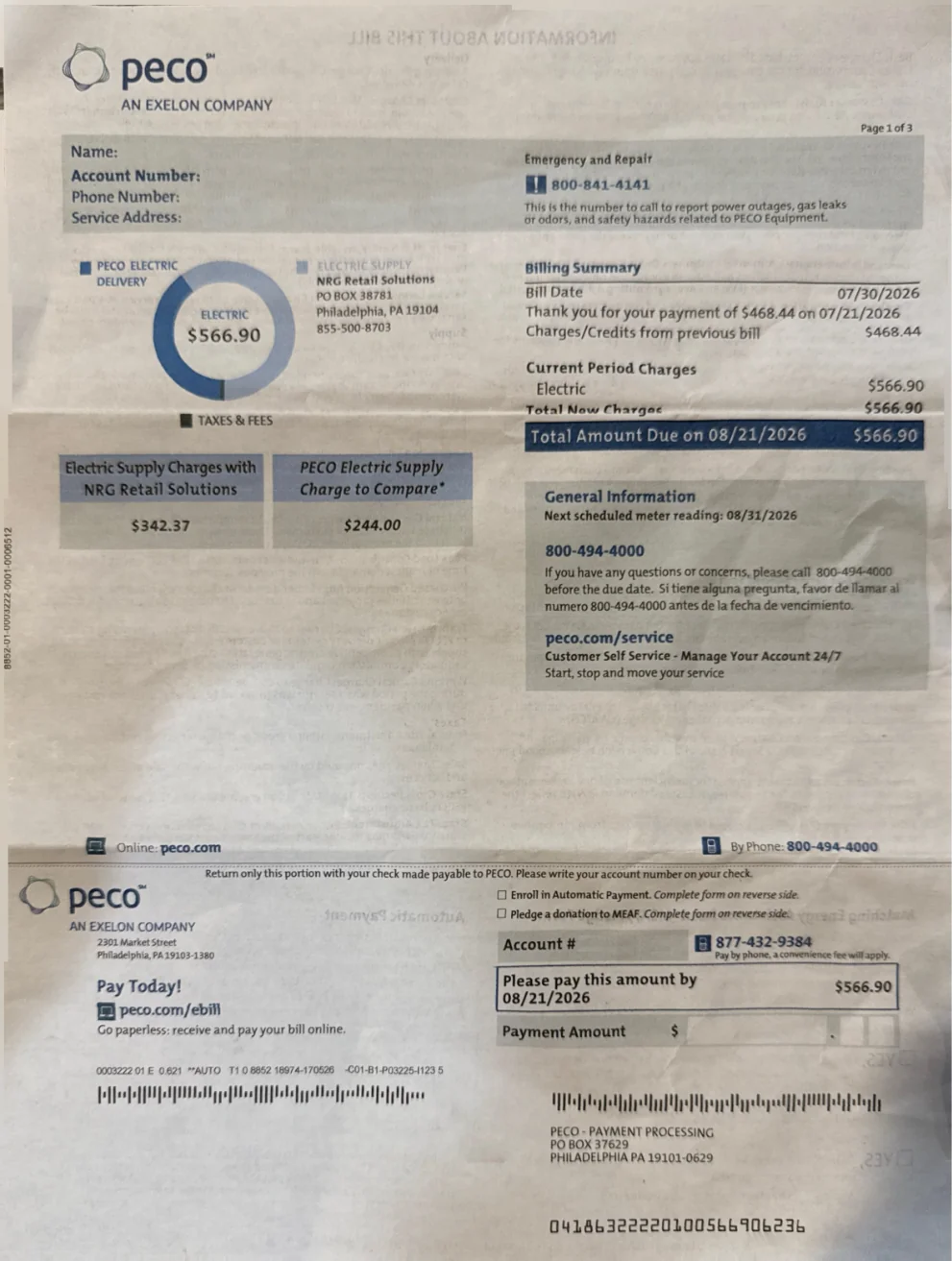
Every utility in the region prints what you need on page one or two: total kWh, the supply charge with its rate, and the billing period dates. That’s true at PPL, PECO, Met-Ed, Penelec, Duquesne Light, PSE&G, and Atlantic City Electric and Delmarva Power, both of which we cover in the regional rates hub. If you want a line-by-line walkthrough of what each charge means, we broke one down in how to read your electric bill.
Why did my electric bill spike this month?
A sudden jump almost always has a specific cause. Slow rate creep doesn’t produce a shock, it produces a slow grind. So when the number genuinely surprises you, start here:
- A longer billing cycle. Thirty-four or thirty-six days instead of the usual twenty-nine.
- An estimated read followed by a true-up. The utility guessed low, then caught up all at once.
- A rate change that landed mid-season, when your usage was already at its peak.
- Something new and hungry plugged in: a space heater, a portable AC, a dehumidifier in the basement, an EV charger, a hot tub, heat tape on the gutters.
- Weather. A five-day stretch below 20 degrees in January, or a humid week in the 90s in July.
Work through it in order. Check the cycle length and whether the read was estimated or actual. Then compare your rate to last month, because two or three cents across 1,200 kWh is about $30 a month. Then think back through the month: houseguests, a kid home from school, a new work-from-home schedule, a renovation running a dehumidifier around the clock.
If usage looks high and you truly can’t account for it, call your utility and ask for a meter verification. Most of them also offer a subsidized or free home energy audit, which is the fastest way to find something drawing power that shouldn’t be.
Why are electricity rates rising in PA, NJ, and DE?
The most common question we get is some version of “why did my electric bill go up if I didn’t change anything?” Usually the answer is that the rate went up.
Your bill has two halves. Supply, sometimes called generation, is what it costs to produce the electricity. Delivery, sometimes called distribution, is what it costs to move it through the poles and wires to your house. They move independently, and lately both have moved up. Utility companies can also change pricing structures or file for rate increases that affect what customers pay. Utility rates have generally climbed over the past decade.
Here’s what actually changed in the region:
PPL, Pennsylvania**.** In June 2026 the PA Public Utility Commission approved PPL’s first distribution rate increase since 2016. For a residential customer at 1,000 kWh, that’s about $6.48 a month, or 3.23%, effective July 1, 2026. Separately, PPL’s supply rate (the Price to Compare) reset in June to roughly 13.1 cents, which the utility tied to higher generation costs on the PJM grid, including higher fuel costs. That default supply rate is up around 66% since 2020. Full detail, including how the Price to Compare works and when to shop it, is in our PPL electricity rates guide.
Delmarva Power, Delaware**.** A supply increase of 18 to 20% took effect June 1, 2026, worth about $14.64 a month on a typical bill, or roughly 9% overall. Delmarva has been blunt that this piece “is not something the company controls,” since it comes out of Delaware’s electricity auction. A distribution rate request filed back in January 2026 could add more later this year if regulators approve it. Delaware homeowners can track where this lands in our PA, NJ and DE electricity rates hub.
PSE&G**, JCP&L and Atlantic City Electric, New Jersey.** The February 2025 Basic Generation Service auction raised supply costs about 17% for PSE&G and 20% for JCP&L, effective June 2025. A lot of households are still absorbing that one, partly because the temporary credit that softened the blow ran out in May 2026. The February 2026 auction was much calmer. PSE&G’s supply rate actually ticked down a hair, mostly because regulators capped how high PJM capacity prices were allowed to go. The full auction history is in our PSE&G electricity rates guide.
We track every utility in the region the same way, so if yours isn’t above, start here: PECO and Met-Ed for southeastern and central PA, Penelec for the northwest, Duquesne Light around Pittsburgh, and the PA, NJ and DE electricity rates hub for the regional picture and the utilities we haven’t broken out yet. Running a business rather than a household? Rates work differently there, and we covered it in commercial electricity rates.
Why natural gas sets your price even if you don’t burn any
PJM is the grid operator coordinating power across Pennsylvania, New Jersey, Delaware and ten other states plus DC. Two separate markets inside it affect your bill, and people mix them up constantly.
The energy market sets the price of electricity hour by hour. In most hours, the last plant needed to meet demand is a natural gas plant, and it’s the most expensive one running. PJM’s rules say every generator running that hour gets paid that same clearing price, whether it’s gas, nuclear, wind or solar. So a rise in gas prices doesn’t just make gas-fired power more expensive. It lifts the price of nearly all the electricity on the grid in that hour. That is the main reason your bill can climb while your usage sits perfectly flat.
The capacity market is a different auction. It pays plants simply to be available on the handful of highest-demand days each year. It has also spiked, but for its own reason: demand is growing faster than new plants are getting built, with data centers a big part of that growth. It’s a supply-and-demand story, not a gas story. Worth separating, so you don’t attribute every increase to gas prices.
Both of these land in the same place on your statement, the supply charge, not delivery.
One more thing that catches people. If a fixed-rate contract with a competitive supplier expired, you may have rolled onto a variable rate or back onto the utility’s default. Both are usually pricier and both ride the swings above, so it is worth checking your contract end date.
You can’t do anything about PJM. You can do something about how many kilowatt-hours you need from it.
How much does weather change your bill?
In the Mid-Atlantic, weather is the single biggest reason bills swing across the year. Heating and cooling dominate home electricity use, water heating comes next, and all of it tracks the thermometer.
Electric resistance heat is the expensive one. Baseboards, an electric furnace, a space heater running in a cold bedroom. A January cold snap with several days below 20 degrees can nearly double a home’s consumption when heating is mostly electric. HVAC alone can be more than half your bill during a peak heating or cooling month. A heat pump does the same job for a fraction of the electricity, which is why it’s usually the highest-return upgrade in an all-electric house.
Summer works the same way in reverse. Air conditioning averages about 19% of home electricity use nationally across a full year, but during a July heat wave in PECO, PSE&G or Delmarva territory it can be half your monthly bill or more. On time-of-use plans, peak hours often run from 4 PM to 9 PM, and electricity can cost up to three times more during those periods. Shore houses in Cape May or Sussex County have it worse, because humidity keeps a central air conditioner and dehumidifiers running during extreme weather.
Always compare to the same month last year rather than to last month. March against April just shows you spring arriving. If you want the technical version, look up heating and cooling degree days for your area: more degree days means more work for your HVAC, and a bill that looks alarming may be completely normal for an unusually brutal month.
Is your house wasting what you’re paying for?
If usage looks high even after you account for the season, the house itself may be the problem.
The housing stock around here doesn’t help. Philadelphia row homes, 1950s and 60s ranches in Bucks and Montgomery County, older shore houses in Ocean and Cape May, Wilmington twins. Insulation and air sealing were afterthoughts in most of them, and sealing and insulating properly are often the most cost-effective energy-saving improvements for heating and cooling costs. Most U.S. single-family homes are under-insulated.
You can usually feel the leaks. Cold air moving past an outlet on an exterior wall. A window that’s noticeably chilly to stand near in January. Daylight under the back door. These air leaks and poor insulation push overall energy use higher. Weatherstripping, caulk, door sweeps, foam gaskets behind outlet covers and window film kits cost very little and are a Saturday’s work. Improving insulation can cut total electric bills by about 11%, while poor insulation can drive them up by about the same amount.
Then there’s maintenance nobody enjoys. Dirty filters, clogged coils, low refrigerant. All of them make a heat pump or an AC run longer for the same result, and older hvac systems lose efficiency over time and use more energy even when they still run. Change filters every one to three months, get a tune-up once a year, and you’ll see it.
For anything you can’t see, a professional home energy assessment will find it. A home energy audit can identify insulation issues, air leaks, and inefficient equipment, which helps improve energy efficiency. PA, NJ and DE all have utility or state programs that subsidize them, and some are free.
What’s quietly using electricity you never notice?
Not every increase comes from something big. Some of it is a hundred small things.
Plenty of electronics pull power while switched off, a standby drain often called vampire energy, and phantom loads can account for about 5-10% of total energy use. TVs, game consoles, cable boxes, routers, smart speakers, chargers left in the wall, computers asleep instead of shut down; unplugging chargers when not in use helps reduce that standby drain. Individually it’s pennies. Across a whole house it isn’t. Smart power strips cut the ones that don’t need standby and help save electricity.
An electric water heater is one of the bigger household energy users, so hot water habits matter, and electric water heaters significantly contribute to household energy consumption. Long showers, half-full loads of hot laundry, a faucet that drips hot. Set the tank to 120 degrees, which saves energy without anyone noticing, and wash laundry with cold water.
Life changes show up on the bill too. Kids home for the summer, a parent moving in, a permanent work-from-home schedule. The house that used to sit empty from 8 to 6 is now lit, heated and full of running laptops. A second fridge in the garage, a chest freezer, a basement dehumidifier and a space heater each draw more than people expect.
Walk the house once with a notepad and list everything that stays plugged in around the clock. Most people find three or four things that don’t need to be.
Or is it just a billing quirk?
Most utilities bill on a 28 to 32 day cycle. Holidays, meter access problems or an account change can stretch it to 34 or 36. A cycle that’s 20% longer produces a bill that’s 20% higher at identical daily usage. Check the dates before you panic.
Estimated reads are the other one. When the utility can’t get to the meter it estimates, and the next actual read brings a catch-up bill covering everything the estimate missed.
Supply plan changes catch people too. Fixed-rate contracts expire quietly and roll you onto a default or variable rate; by contrast, a fixed rate plan usually gives you more predictable bills than a variable rate after a contract expires, and some third-party suppliers write teaser rates that reset hard after six or twelve months.
If something looks wrong: check the statement for an “estimated” flag, confirm the period dates, see whether it was the delivery charge or the supply rate that moved, and call for a meter verification if the usage still makes no sense.
Why is my electric bill so high in PA vs NJ vs DE?
People compare notes with friends across state lines all the time and wonder why a cousin in Pennsylvania pays less than they do in New Jersey. All three states sit on the same PJM grid, so the wholesale story is shared. What differs is delivery charges, state regulation and local infrastructure costs, including the role of the utility company in delivering electricity and maintaining the power grid.
Some PSE&G and Atlantic City Electric customers pay more per kWh than customers of certain PA utilities. In Delaware, Delmarva’s distribution piece alone went from about 5.7 cents to 7.1 cents since 2020, a 25% climb. And coastal homes in both NJ and DE run higher summer usage because of humidity, dehumidifiers and houses that fill up seasonally.
Pennsylvania. Rate cases at PPL, PECO and Met-Ed pushed distribution costs up, and aging parts of the electric grid also help explain why regional costs do not land the same everywhere. A lot of the older housing stock runs on electric heat, which makes a cold snap genuinely painful.
New Jersey. Higher average residential rates meet heavy air conditioning use in dense suburban housing. Summer is the season that hurts here, and the PSE&G rate history shows how quickly the supply side moved.
Delaware. A smaller market, but prices have risen steadily and older homes in Wilmington and along the coast don’t hold conditioned air well. Delmarva’s increases are tracked in the regional rates hub.
The troubleshooting is identical in all three: rate, usage, billing cycle, efficiency.
How to lower your electric bill now
You don’t need a new roof or a solar contract to start. Every kilowatt-hour you don’t use is one you don’t pay a rising rate for, and that’s the whole point.
- Thermostat: around 68 in winter when you’re home, lower when you’re out or asleep. 76 to 78 in summer with ceiling fans running.
- Seal the obvious leaks at windows and doors with weatherstripping and caulk.
- Replace whatever incandescent bulbs are left. LEDs use a fraction of the power.
- Put the TV wall and the office setup on smart power strips.
- Shorter showers, full dishwasher loads, full laundry loads.
- If you’re on a time-of-use plan, move laundry and dishes to off-peak hours.
- Clean the refrigerator coils and change HVAC filters on schedule.
Then do a walkthrough. Every room, listing anything that makes heat or cold: space heaters, dehumidifiers, the old fridge in the garage, a portable AC. An older refrigerator is one of the classic inefficient appliances in a house; these kinds of energy hogs can use around 35% more electricity than a current efficient model and add hundreds to annual electricity costs, which is why a garage fridge from 2003 running next to a new kitchen one is one of the most common findings in a home audit.
If your central AC is fifteen years old, or you’re still heating with resistance baseboards, a heat pump upgrade deserves serious thought, and smart thermostats are another practical step. Whatever you change, track your kWh for two or three months afterward. That’s the only way to know whether it worked.
When does solar make sense?
Efficiency and better habits help, and for some homeowners that’s enough. Others want out of the rate escalator entirely, and that’s what solar does. It can lower an electricity bill by converting a cost that changes every June into one you set once. Solar power can let some homeowners generate their own power and reduce exposure to rising utility rates and electricity prices.
Homeowners with solar commonly see utility bills fall 50 to 75%, and some eliminate the energy portion outright. The economics work because you’re locking in a large share of your electric cost at today’s price rather than paying whatever PJM decides next year. Typical payback lands in the 6 to 10 year range, and the equipment runs 25 to 30 years with very little spending after that. Homeowners who install solar panels often pair that move with efficiency improvements first or alongside it to cut energy consumption and lower energy costs. We walk through the real numbers in how much solar costs and the state-by-state returns in solar ROI in Pennsylvania and solar ROI in New Jersey.
Solar is usually a good fit when:
- You use 700+ kWh a month and your bills run above $140 to $160
- You expect to stay in the house at least five to seven years
- Your roof gets decent sun to the south, east or west without heavy shading
- You’re in a net metering friendly utility territory in PA, NJ or DE
- You can use the federal tax credit and state programs like Delaware’s incentives
Energy efficient upgrades like heat pumps and Energy Star products can cut how much energy a home needs before sizing solar.
Sunwise Energy designs and installs residential solar across Pennsylvania, New Jersey and Delaware. We add battery backup so the essentials stay on during an outage, coordinate roofing when the roof needs to go first, and offer $0 down financing so the upfront number isn’t the obstacle.
If you’re tired of watching this bill climb every June, send us a recent bill for a free review. We’ll tell you what solar would realistically do to your energy bill and how long the payback takes on your house specifically.
Why Is My Electric Bill So High? FAQ
Why is my electric bill so high in PA?
Two things stacked up in 2026. PPL’s first distribution rate increase since 2016 took effect July 1, and its supply rate reset higher the same month, both driven by generation costs on the PJM grid. On top of that, a lot of Pennsylvania housing stock runs on electric heat, so a cold January hits harder here than it does in a gas-heated house.
Why is my electric bill so high in NJ?
New Jersey’s 2025 Basic Generation Service auction raised supply rates roughly 17% for PSE&G and 20% for JCP&L starting June 2025, and the credit that softened it expired in May 2026, so many households are only now feeling the full amount. The 2026 auction came in much flatter after regulators capped PJM capacity prices.
Why is my electric bill so high in DE?
Delaware has seen electricity supply rates increase by about 18-20% in 2026, adding roughly $15 to the average monthly bill. Delivery charges have also risen 25% since 2020. Older homes with poor insulation and coastal humidity increase heating and cooling use, further raising bills. These factors combined explain why your electric bill in Delaware might be higher than expected. Why does natural gas affect my electric bill if I don’t have gas serv
Why does natural gas affect my electric bill if I don’t have gas service?
In PJM’s energy market, a natural gas plant is usually the last and most expensive generator needed to meet demand in a given hour, and every plant running that hour gets paid that same price no matter what fuel it burns. Gas prices therefore set the price of nuclear, wind and solar generation too. That’s why an all-electric home’s bill still tracks natural gas.
Why is my electric bill still high even with solar panels?
Usually one of four reasons: the system was sized for your usage before you added an EV or switched to electric heat, winter output is naturally far below summer, something is underperforming (inverter, shading, degradation), or you were moved onto a different rate plan at installation. Check your monitoring app against the original production estimate first.
Is this rate increase happening to everyone, or just me?
It’s regional. PPL, Delmarva Power, PSE&G and JCP&L have all raised rates within the past year, largely for the same underlying reasons. If your bill jumped and your kWh didn’t, a billing error unique to your account is unlikely.
How much could I save with solar?
It depends on your usage, your roof and your utility, but most homeowners see their grid-supplied electricity cost drop substantially, with systems commonly paying for themselves in 6 to 10 years and producing for 20 or more years after that. A free bill review gives you the real number for your house.
Will electric rates keep rising in PA, NJ and DE?
Most likely, and unevenly. As long as natural gas sets the marginal price for most hours on the PJM grid, and demand growth including data centers keeps pressure on the capacity market, rates will stay volatile with an upward trend. We update the PA, NJ and DE electricity rates hub each time a utility files or an auction clears. Reducing how much grid electricity you rely on is the main way to limit your exposure to that trend.